
Blackjack Strategy 101: How to Play Like a Pro
Blackjack is one of the most popular casino card games because it combines simple rules with strategic decision-making. Unlike many casino games that rely entirely on luck, blackjack allows players to influence the outcome through smart choices.
With the right approach, players can reduce the house edge significantly and improve their chances of winning. Learning the fundamentals of blackjack strategy is the first step toward playing the game more effectively.
This guide explains the core strategies and techniques used by experienced blackjack players.
Understanding the Objective of Blackjack
The main goal in blackjack is simple: beat the dealer’s hand without exceeding a total of 21.
Each player competes against the dealer rather than against other players at the table.
Card values are straightforward:
- Number cards (2–10) are worth their face value
- Face cards (King, Queen, Jack) are worth 10
- Ace can count as either 1 or 11
A hand totaling 21 with the first two cards (an Ace and a 10-value card) is called a blackjack and usually pays higher than a regular win.
Learn the Basic Blackjack Decisions
Every blackjack hand requires players to make strategic decisions based on their cards and the dealer’s visible card.
Hit
Choosing to hit means asking for another card to improve your hand total.
You should usually hit when:
- Your total is 11 or lower
- Your total is 12–16 and the dealer shows a strong card
Stand
Standing means keeping your current hand and ending your turn.
Players often stand when:
- Their hand totals 17 or higher
- The dealer shows a weak card
Double Down
Doubling down allows you to double your bet after receiving the first two cards and receive only one additional card.
This move is usually favorable when:
- You have a total of 10 or 11
- The dealer shows a weaker card
Split
If your first two cards are a pair, you can split them into two separate hands, each with its own bet.
Common situations to split include:
- Aces
- 8s
Splitting gives players a better chance to build strong hands.
The Importance of Basic Strategy Charts
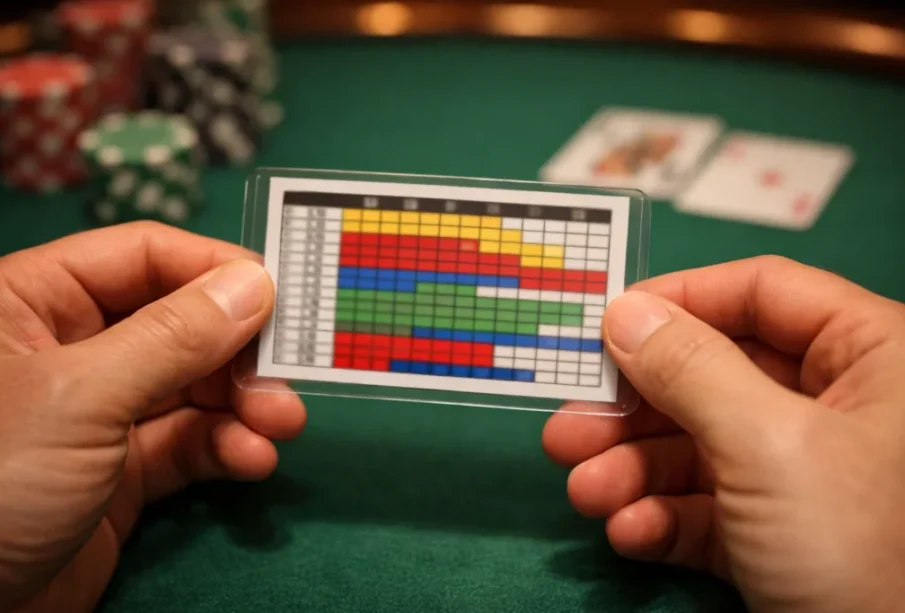
Professional blackjack players rely on basic strategy charts, which outline the mathematically best decision for every possible situation.
These charts are based on millions of simulated blackjack hands and are designed to minimize the house advantage.
A basic strategy chart tells you when to:
- Hit
- Stand
- Double down
- Split pairs
Using basic strategy can reduce the house edge to less than 1% in many blackjack games.
Understanding Soft and Hard Hands
Blackjack hands are categorized as either soft or hard, which affects the best strategic decision.
Hard Hands
A hard hand does not contain an Ace counted as 11.
Example:
- 10 + 7 = Hard 17
Hard hands have less flexibility because their value cannot adjust.
Soft Hands
A soft hand contains an Ace counted as 11.
Example:
- Ace + 6 = Soft 17
Soft hands provide flexibility because the Ace can also count as 1, reducing the risk of busting.
Players often hit more aggressively with soft hands since the risk of exceeding 21 is lower.
Managing Your Blackjack Bankroll
Even the best strategies cannot eliminate the house edge completely, so bankroll management is essential.
Smart bankroll practices include:
- Setting a fixed budget before playing
- Avoiding large bets after losses
- Keeping bet sizes consistent
- Taking breaks during long sessions
Maintaining discipline helps players enjoy the game without risking unnecessary losses.
Pay Attention to the Dealer’s Upcard
The dealer’s visible card provides valuable information that should influence your decisions.
Dealer cards can be grouped into two categories.
Weak Dealer Cards
These include:
- 2, 3, 4, 5, 6
When the dealer shows these cards, there is a higher chance they will bust.
Players should often stand on moderate totals and let the dealer take the risk.
Strong Dealer Cards
These include:
- 7, 8, 9, 10, Ace
In these situations, players may need to take more aggressive actions, such as hitting or doubling down.
Avoid Common Blackjack Mistakes
Many beginners make errors that increase the casino’s advantage.
Common mistakes include:
- Ignoring basic strategy
- Taking unnecessary insurance bets
- Chasing losses with larger wagers
- Playing emotionally instead of logically
By avoiding these habits, players can improve their long-term results.
The Role of Card Counting
Card counting is a technique used by some advanced players to track the ratio of high cards to low cards remaining in the deck.
When more high-value cards remain, the odds of strong player hands increase.
However, card counting has limitations:
- It requires significant practice
- Casinos monitor players for counting behavior
- Many casinos use multiple decks to reduce its effectiveness
For most players, mastering basic strategy is far more practical than attempting card counting.
Choosing the Right Blackjack Table
Not all blackjack games offer the same rules, and some are more favorable to players.
Look for tables with:
- 3:2 blackjack payouts instead of 6:5
- Fewer decks in play
- The ability to double down after splitting
- Dealer standing on soft 17
These rules reduce the house edge and improve your chances of success.
Practice Before Playing for Real Money
One of the best ways to improve blackjack skills is through practice.
Many online platforms offer free blackjack games where players can:
- Learn the rules
- Test strategies
- Understand betting decisions
Practicing helps build confidence before wagering real money.
Conclusion
Blackjack is unique among casino games because strategy plays a major role in the outcome. Players who understand the rules, follow basic strategy, and manage their bankroll carefully can significantly reduce the house edge.
Learning when to hit, stand, double down, or split makes a major difference in long-term results.
While no strategy guarantees consistent wins, applying these professional techniques allows players to approach blackjack with confidence and discipline.
Frequently Asked Questions (FAQ)
1. What is the best starting strategy for blackjack?
The best approach for beginners is to follow a basic strategy chart, which provides mathematically optimal decisions for each situation.
2. Does blackjack involve skill or just luck?
Blackjack involves both luck and skill. Strategic decisions can reduce the house edge and improve long-term outcomes.
3. Is card counting illegal?
Card counting is not illegal, but casinos may ask players to leave if they suspect counting activity.
4. Why should players avoid insurance bets?
Insurance bets generally have a higher house edge, making them unfavorable for most players.
5. How much bankroll should I bring to a blackjack table?
A common guideline is to bring at least 50–100 times your average bet size to manage variance.
6. What does “busting” mean in blackjack?
Busting occurs when a hand exceeds a total value of 21, resulting in an automatic loss.
7. Can blackjack strategy guarantee consistent profits?
No strategy guarantees profits because blackjack still involves randomness, but proper strategy significantly improves a player’s odds.